


ATR Media Integration & Communications Research Labs
Development of Walk-through Sensation Display Equipjment
ATLAS
Tel-e-Merge: Communications for "I wish you were here."
Haruo Noma and Tsutomu Miyasato
We have been developing a new communication style for "I wish you were here".
This method will make it possible to merge a remotely-located person into the
space that one is currently in. In other words, the method will exchange existences
for communications based on teal space. In this article, we introduce our tele-robot
and locomotion interface by which a user can control the robot.
1. Introduction
As an example, let's say that a person encounters a beautiful scene that s/he
has never had the chance to experience before. That person will perhaps get the
feeling of naturally wanting to tell a close friend or family member of his/her
experience. To accomplish this, the person may take a photograph or record the
scene on video. However, there is no doubt that the best way of relating this
experience is to bring that person to that location at that time. Not only does
this introduce information such as words and images for the other side to understand
one's internations and feelings in a kind of daily communications that suddenly
swells up, but the environments the speakers are in and the information that each
experiences also become important.
Accordingly, we applied Virtual Reality (VA)* technology, and proposed
the Tel-e-Merge environment, i.e., a new communications method that carries out
a dialog by entering the environment of the partner of the dialog.1
2. Communications Using Tel-e-Marge
As shown in Figure
1, the site of a dialog in the Tel-e-Merge environment (SiteA) is an environment
that one of the users exists in. The user existing in this environment (Tele-Inviter)
can drag another user (Tele-Visitor) at a remote site (SiteB) into his/her environment.
At this time, the location of the dialog for the Tele-Visitor is artificially
composed by VR technology.
The main point of the Tel-e-Merge environment is not only to display a sense of
existence of the remote partner in the dialog (i.e., the Tele-Visitor who enters
the environment of the Tele-Inviter), that is, to simply exchange uttered sound
and image information, but also to offer a dialog technique that aims at mutually
transmitting a sense of self-existence to provide information.
As one of the implementation forms of Tel-e-Merge, we have developed a type of
communications equipment able to present a sense of "talking while walking together
with one's remote partner in a dialog". The equipment consists of ATLAS (ATR Locomotion
Interface for Active Self-Motion; Figure
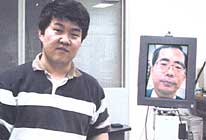
2) and AIR (Advanced Imaging Robot for Tel-e-Merge; Figure
3). ATLAS measures the waling motions of the remote partner and offsets the
walking motions of the remote partner and offsets the walking motion. ATR is a
robot that moves in response to the motion of the ATLAS user. At the site where
the conversation is held, AIR moves in connection with the movement of the remote
user on ATLAS. AIR has a videophone function, and provides a channel for conversation
with the ATLAS user while achieving a "corresponding sense of existence" display.
At this time, the ATLAS user can get a sense of walking freely in the dialog from
his/her own room.
3. ATLAS
ATLAS is a locomotion interface for active self-motion that aims at offsetting
the free walking of the Tele-Visitor, that is, the forward walking movement of
the Tele-Visitor at optional speeds, as well as course change movements curving
to the right or left, and also aims at maintaining the Tele-Visitor at a constant
point indoors no matter how the Tele-Visitor moves. In particular, with the ATLAS
prototype, a user merely attaches reflective markers on the toes and puts on the
equipment, and by only doing typical free walking movements without consciously
operating ATLAS consciously, can have his/her walking conditions measured and
his/her walking movements offset.
The basic procedure for achieving this is same as for the movement equipment simulators
for conventional vehicles, which measure movements and then offset these movements.
Developing a practical walking simulator had been difficult, however, because
in walking movements the behaviors of the human body and the correspondence of
movements are complicated, while in the vehicle simulators the flow of information
between the user and equipment is simple (since devices are introduced) and the
calculation processing is easy. We solve these problems with a technique to offset
movements by making the whole belt mechanism rotate, i.e., ATLAS estimates walking
movements with a CCD camera (by measuring the user's movements), offsets forward
movements by using a fast-responding belt mechanism, and then works in course
changes (Figure 4).2
The first ATLAS prototype shown in Figure
2 consists of a treadmill (controlled by a computer) and three-axes motion
platform, and moreover, a CCD camera set at the tip of the treadmill. It judges
the conditions of both legs by comparing the belt speed with results obtained
by measuring (with the CCD camera) the movements (Figure
4(a)) of the toes (attached with markers) of the user who is walking. Through
preliminary measurements, it can be determined that the walking speed and standing
time are in an inverse proportional relationship and that ATLAS can estimate the
walking speed using this relationship. ATLAS controls the belt speed by combining
feedforward control using the above speed estimation results and pedestrian position
feedback control on the belt to compensate for estimated result errors, and accordingly,
the walker is always maintained at a fixed point on the belt (Figure
4(b)).
On the other hand, we aimed at the difference in the trajectory of the free leg
while the user was walking, against course change movements to the right or left.
In straight walking, the free leg touched down while drawing an almost bow-like
trajectory to the front. During course changes, the free leg largely deviated
out obliquely to the front. ATLAS always monitors these movements with the CCD
camera, and adopts a technique (Figure
4(c)) to offset course change movements by making the belt surface itself
rotate horizontally to the motion platform, and by making a leg going in an oblique
direction always land at the center of the belt.
In addition, with the prototype, we experimentally created a mobile robot called
AIR, which obtains and presents the landscape and sounds of the site where the
Tele-Inviter is, to the Tele-Visitor on ATLAS. The walking movements of the Tele-Visitor
measured by ATLAS are transmitted to AIR, and AIR moves to the environment of
the Tele-Inviter with the same walking movements of the Tele-Visitor. In addition,
at the top of AIR, because a monitor (showing face images of the ATLAS user) and
speakers are attached, we can show the existence of the ATLAS user, i.e., the
Tele-Visitor, to the Tele-Inviter, as a movable videophone. In contrast, we display
the remote information that AIR sends to the ATLAS user via an HMD (Head Mounted
Display) or on a large screen positioned around ATLAS. Through all of this, a
kind of bi-directional communications equipment could be achieved rich in a sense
of immersion based on a real sense display technique.
4. Conclusion
The environment achieved by ATLAS merely functions as a kind of conversation equipment
during a walk with a remote person in the present situation. As future developments,
we are planning to apply the method to control procedures for advanced robots
in restricted working environments and next-generation broadcasting techniques
able to reproduce content in the home (with a force in the neighborhood of a player
in, for instance, sports casting).
Reference


