


ATR Media Integration & Communications Research Labs
Reproducing the Reality of the Appearance and Motions of
Natural Scenes in Virtual Worlds
Modeling and Animating Botanical Trees from Real Images
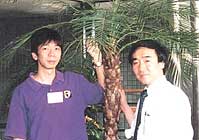
Tatsumi Sakaguchi and Jun Ohya
Botanical trees are one of the most important objects in natural scenes. We therefore
introduce our project on a botanical tree modeling that can preserve the reality
of the appearance and motion of real trees. Our method consists of:
(a) a method for reconstructing the branch structures of a real tree from real
images, and
(b) a method for reproducing the motions of the tree model in response to external
forces. Experimental results show the effectiveness of our method.
1. Introduction
The chances of viewing images created with computer graphics (CG) on television
or in today's movies have increased dramatically. As an example, one of the current
topics concerning CG use has been about the recently released movie "The Ogabtin
Nebace- Star Wars Episode 1", where the planet of main stage and all of the creatures
in the movie are drawn by CG. At present, CG is becoming an indispensable element
in the creation of pictures. To date, however, artists have had to manually create
CG and this has involved enormous amounts of time and money.
One of the aims at ATR Media Integration & Communications Research Laboratories
is the creation of communication techniques that utilize virtual environments
accommodating people separated by distance. Such communication environments are
typically created using CG technology, and accommodate the reproduction of appearance
from arbitrary viewpoints as well as the expression of movements. It is , however,
inefficient to create virtual environments entirely by CG from the viewpoints
of time and cost as mentioned above.
Accordingly, considerations have been made on using real images. In the past,
scenes were restored in 3-D based on the principle of stereo matching involving
camera images from multiple cameras, but a serious problem emerged, i.e., the
lack of data in the regions unobservable from the actual cameras when the viewpoint
was moved. Another problem was the impossibility of reproducing movements of objects
contained in the scene with this method.
Here, we use real images and investigate a method that reproduces the appearance
of natural scenes and the reality of movements by using CG technology. We adopt
"botanical trees", the most important elements to express a natural scene, as
the objects of our investigation.
2. Creating 3-D Models of botanical Trees from Photographs
To reproduce the appearance of real botanical trees and the reality of movement,
we have decided to create 3-D CG models of botanical trees by using real images.1
Methods that use the image processing shown in Figure
1 and methods that depend on the skills of artists can be considered when
attempting to model real botanical trees, but there and problems (see section
1). In the field of CG, fractals*
and methods based on the growth rules of botanical trees have been investigated,
but real botanical tree images have been unsuitable for the modeling of existing
botanical trees even though generation has been possible.
Figure 1 shows the principle of our
method. As shown in the figure, from pictures of a real botanical tree taken from
multiple viewpoints, we project silhouettes of the botanical tree in 3-D space
from individual images to reproduce the whole shape of the botanical tree, and
obtain a solid (i.e., the volume data) defined from their overlaps. Next, we generate
branch structures that determine the appearance of the tree. Then, we obtain evaluation
values, each corresponding to a possibility value that a part is related to the
trunk, a branch structure, or leafy area from the original images and record its
corresponding location within the volume data. If a branch segment (i.e., a branch
structure generated by a branch structure appropriately connecting a branch segment
with blocks of columns) expands within the volume data, the branch is made to
exist densely in a direction with a high evaluation value (mentioned above). Here,
we have developed rules so that branches are projected from the volume data and
unnatural growth like twisting does not occur. In this way, a 3-D model of a botanical
tree similar to that in Figure 2 is
completed by attaching models of leaves (whose textures are from the original
images) created beforehand to each branch segment (corresponding to the projected
structure).
3. Botanical Trees that a Virtual Wind Can Shake
A botanical tree should transform and move in response to interaction from the
outside world, such that it moves when the wind blows and bends when a person
grabs it, and should not have a rigid body like a rock. It is therefore important
to be able to reproduce movements in response to such interaction, as a function
necessary for the botanical tree model generated in section 2. The conventional
technique had taken only the movements of joints of branch segments into consideration
to express changes in the tree model, and because in most cases the movements
of the branch segments themselves had not been considered, problems remained in
the quality of expressing such movements.
In contrast to this, as shown in Figure
3, we build a movement equation beforehand that individually considers external
forces (e.g., wind force, hand grip force, etc.), the restorative force towards
these external forces, and axial damping forces at the joints with neighboring
segments, for each branch segment, and then calculate the movement at each step
in time.2
In the results of the movement calculation, neighboring segments are completely
separated, but systematically connect branch segments by a method that considers
the consistency of the entire branch structure; this is because we do not consider
the connection condition of each segment.
Figure 4 shows an example of expressing
the movements of a botanical tree. The appearance in which the botanical tree
model is blown by a virtual wind appears very lifelike, and moreover, our aim
of real-time processing is achieved.
4. Conclusion
We have introduced a 3-D modeling method for botanical tress from real images,
but remaining problems include improving the approximate precision towards real
trees and extending towards various types of botanical tress. Moreover, we want
to extend the proposed method to other objects with natural backgrounds and proceed
with research with the final aim being the realization of a system with which
anyone can easily make movies on their own.
Reference


