


Preparing to Cross International Borders
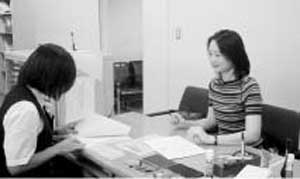
At the immigration bureau
Ms. Mikami
It was soon after I was assigned to my present job that an unexpected event happened.
The incident made me realize for the first time in my life how hard it is for
foreign researchers to make preparations to cross international borders into Japan.
I was winding up a long day of work, and it had already become dark outside when
the phone at my desk rang. As I answered it, I heard a voice, "Hello?" This caught
me by surprise ム it was an international call. Since I mostly used email for communicating
with people overseas, I remembered feeling it was a new experience at the time.
"My family and I will be heading for Japan on a flight departing in three hours,
" the person on the line said, "but it seems that my wife accidentally threw away
our CE (Certificate of Eligibility) documents. What should we do?" (As described
in detail later, to put it simply, a CE is a document that is necessary to receive
approval for a visa and to enter Japan. It is no exaggeration to say that it is
the most important travel document next to a passport.) To make matters worse,
the researcher and his family were so relieved at receiving the CE documents that
they had failed to submit visa applications for processing at the Japanese consulate
before entry into the country. Despite this situation, the person said that they
wanted to avoid canceling the flight by all means. If I were in their place, I
perhaps would also have hoped to get on the flight as scheduled and enter the
country. So I told him that I would call him back and hung up the phone. Then,
I looked up at the clock on the wall. I remember thinking "Oh my I only have five
more minutes until the immigration office closes! " Hoping their lines weren't
busy, I dialed their number. Fortunately, someone answered the phone in the immigration
office, gave me the proper advice, and the researcher and his family were able
to enter Japan as desired. But the paperwork following their arrival was something
I hope to avoid in the future.
Exchanges like this are the kind of work carried out by SHIEN staff when foreign
researchers come to Japan. ATR has already dealt with over 60 CE applications
for the year. To date, researchers from around 40 countries have made CE applications.
These applications must be filed with and approved by the Minister of Justice
prior to the researchers' entry into the country. The ministry checks whether
the purpose of the visit to Japan conforms to the objectives (such as for research
or family residence) approved by the Immigration-Control and Refugee-Recognition
Act. When a person who possesses a CE applies for a visa at a Japanese embassy
or consulate abroad, the screening procedure is simplified. The person can then
more easily enter the country since the procedure has been completed. As you can
imagine, a CE application cannot be processed in one or two days; it takes about
ten weeks from initial preparation.
First, SHIEN staff make inquiries by email to verify all items in the application
form. The staff also ask the researcher to send the necessary documents such as
a university diploma, an employment certificate, and photographs, as well as a
copy of the researcher's passport. If any family members will be accompanying
the researcher, a marriage certificate and if applicable, children's birth certificates
are also required. These original documents are not accepted unless accompanied
by Japanese translations, an additional service provided by SHIEN. During this
process, researchers and SHIEN staff exchange email messages almost daily.
Although a general application procedure exists, the actual process does differ
slightly with each researcher's unique circumstances and employment objectives.
For example, consider someone who has recently had a child while traveling abroad
and has not yet returned to his or her home country to complete the birth registration
procedures. In such a case, since the child has no nationality, confusion arises
over how to complete the application form. In another example, even though a researcher
may enter his or her name in the application form exactly as it appears in the
passport, the immigration officer seeing a name entered in the Roman alphabet
may request that the name should be written in Chinese characters, since the person
has a kanji name. (Kanji or Chinese characters are ideograms originating from
China that represent words.) In this case, SHIEN staff must ask the researcher
to submit his or her kanji name by fax.
Even though the job simply involves "filling out an application form," straightening
things out does present a kind of challenge. When the documents are somehow arranged
without problems after what seems to be a desperate struggle, SHIEN staff can
finally submit the application to the immigration office. After screening that
takes three to six weeks, a CE is issued and sent to the researcher. Upon receiving
the authorized CE, the researcher follows the visa procedure and reserves a flight.
At last, the date of departure is set.
On the long-awaited day of the researcher's arrival in Japan, when we finally
meet in person, I feel as if I have finally met a long-lost family member. All
of my difficulties to that date are blown away in one breath. And because I want
to see another smiling face arriving from overseas, I cheerfully sit at my desk
again today.
TATSUMI Makiko, SHIEN


