


My Memories of ATR Meddia Integration & Communications Research
Laboratories at the Conclusion of the Project
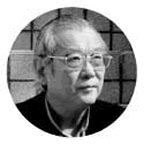
SAKANE Itsuo Institute of Advanced Media Arts and Sciences (IAMAS),
Gifu, Japan
I first visited ATR in May 1996 to participate in an Art & Science symposium.
I attended at the invitation of Dr. NAKATSU Ryohei, Christa Sommerer and others.
Before that, I was only aware that a leading research laboratory named ATR existed
in the Kansai region. I was greatly surprised to see that this great science city
had emerged in the vast natural environment at the border of Kyoto and Nara prefectures.
Christa Sommerer and Laurent Mignonneau, with whom I became acquainted in Linz,
Austria, were working as artists-in-residence at ATR. This heightened my expectations
even further. I had heard about several overseas companies and laboratories retaining
artists-in-residence, but this was the first time I learned of such an initiative
in Japan. Therefore, I was fascinated with the progressive thinking at ATR and
the symposium theme proposed by Christa and others.
Coincidentally, I found that many of the invited panelists at the symposium were
acquaintances of mine from the 1970s, friends of artists, and scientists. On the
first night of the symposium, we got together in Christa's room and enjoyed stimulating
conversations about our academic areas. Our minds, accelerated by alcohol, came
up with quite intelligent and exciting ideas, and I almost failed to notice that
the night was growing old.
Since then, I've maintained a good relationship with ATR and with ATR Media Integration
& Communications Research Laboratories (ATR-MIC) in particular. That relationship
helped Christa and Laurent stay at IAMAS as artists-in-residence for two years,
and in April 2001 they assumed new posts as associate professors at IAMAS. In
addition, I was amazed when the president of ATR-MIC, Dr. Nakatsu himself, collaborated
with Dr. TOSA Naoko in applying for the contest of the L'Oreal Art and Science
Foundation and subsequently won the L'Oreal Prize. After that, a graduate of IAMAS
were sent to ATR, where we were able to expand our relationships globally with
ATR serving as a hub. In 1999, a symposium on the theme "foretelling the future
of media" opened at Keihanna Plaza. My invitation to this symposium allowed me
to further widen my circle by renewing old friendships with Professor Stephen
Benton and Professor Scott Fisher. Since the 1960s, I have insisted on the importance
of collaboration between science and art, believing that the cooperation of creators
would become indispensable across a broad area of study.
While science and technology have led to high civilization in the past, they have
failed to provide a real sense of human well-being. Instead, scientists recklessly
rushed to achieve technical results to answer political and economic needs that
were sometimes promoted by narrow-minded nationalism. Looking back at this situation,
I think it is necessary not only to feed back the values of different fields but
also to nurture world views and humanity among scientists, engineers and artists
beyond each individual's academic area. Such a solution would require fundamental
reforms, including those of the current educational system and academic science.
Until this comes to pass, we should deliberately create an environment in which
scientists, engineers and artists who have grown in each conventional academic
area can coexist and cooperate. That would require teamwork to enable any organization
ム whether government, university, research lab, or private enterprise ム to create
ideas spanning conventional academic areas and to consider each process, including
development goals, even from a public perspective. This task must continue for
at least a half-century. Until then, I think that we must assume the role of catalysts
that stimulate with new visions among research labs led by government and private
enterprise. The practical solution would be to adopt not only an artist-in-residence
system but also a system of recruiting interns from those university students
majoring in art and design.
In that sense, ATR should be highly evaluated for its early adoption of the artist-in-residence
system; its unique research and development activities, such as new methods of
expression through the media; and its study of interface design aimed at stimulating
the five senses. I hope this basic approach will not be discontinued even after
this project ends at ATR. On the other hand, a new phenomenon has arisen in the
area of art. People have started to question the social role of new art, which
has transcended the step of "creating art in order to express oneself," the foundation
on which conventional artists have depended. Also, creators clearly need the current
educational system to advance beyond conventional academic areas such as science,
technology, and art. Even some writers with technical literacy have become aware
of issues from multiple perspectives. As a result, orthodox academic areas have
started to dissolve.
As I stated, ATR has engaged in various research projects related to human communication
for several years. This activity is an experiment in the sense of cooperation
and teamwork between artists and engineers. I have heard that this project is
ending and that a reorganization will soon begin. This presents a good opportunity
to look back at the successful past that resulted in creating great partnerships
and dialogues among science, technology, and art, as exemplified by the artist-in-residence
system. My sincere wish is for ATR to research a new life and a culture that humanity
can truly enjoy.


