


Research to Support Image Expression:
Toward a Technical Understanding and Utilization of Human Kansei
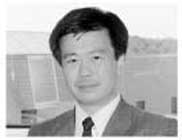
TADENUMA Makoto
What kind of nonverbal communication has been most effective since ancient times?
Ancient mural paintings are powerful enough to evoke images of hunting. When we
cannot communicate effectively with people whose language we do not speak, we
use gestures. Similarly, some people express their emotions through rhythmical
sounds and melodies. Our research focuses on nonverbal expressions of images applying
a kansei (sensitivity) processing technique. Using this approach, we have been
working to establish a support system for enhancing the efficiency of nonverbal
image expression.
Using Paintings or Designs
We sought ways of allowing untrained persons to better express themselves through
painting and photography.
First, we analyzed many master paintings for three major factors: composition,
coloration, and brushwork. From a database of this information, we developed a
painting assistant called "Cyber Atelier1
." The system is a successful integration of three functions: a composition guide
for setting an object in an appropriate location, a color selector for using representative
colors with coloration in proper proportions, and a texture feature for adding
the brushwork of particular master painters to a painting.
We also created "Cyber Photographer," which applies the composition guide. With
this process, a panoramic photograph is segmented into regions according to their
visual appeal. A scene in which the main object is most appropriately located
is cut from it. Next, we developed an "Image Re-Composer2
," which allows extracted objects to be relocated against a different background
while ensuring good composition.
Another trial conveyed messages by using an iconic language with its own rules
to connect icons and communicate effectively. This iconic language was called
"CAILS3
." We tested how well the system conveyed meaning when used in different languages,
thereby proving its effectiveness in cross-linguistic communication. Some encouraging
and heartwarming results were also found in trials with children with disabilities.
Using Body Movement
We selected dance as a method of image expression that uses the body, and we studied
how technology might support it.
We began our experiment by categorizing the impression of dance images into seven
representative categories. After statistically analyzing the relationship between
these impressions and the physical parameters of the dance image, we devised an
equation that approximates the relationship quite accurately. With this technique,
we computerized a system that presumes the kind of image the dancer intends to
express, generates a suitable video and music in real time, and combines those
with the dancer's real image. This interactive dance system, called "MIDAS4
," can emphasize the image that a dancer intends to express (Figure
1). We also experimented with an advanced image support system5
that adds 3-dimensional information to human motion.
Synchronizing Music and Moving Images
We studied the enhanced effect of image expression by synchronizing the rhythm
of music with the rhythm in a moving image. Rhythm can be extracted by analyzing
both the spatial frequency of a visual texture and the optical flow of pixels
across the screen, and by comparing how they vary over time. We established a
method of overlapping multiple images using a script description. This enabled
us to develop the "Image Wave6
" system with which we can synthesize the rhythm in a constructed image in synchronization
with each rhythmic component in music. Experiments show that the system effectively
highlights image-based expression.
Future of the Image Expression Support System
Recently, international academic societies have recognized the importance of kansei
information processing as an essential factor in the development of future communication
systems. One prominent embodiment of this is an image expression support system.
We are confident that this field will advance with deeper study of human kansei.
In that sense, we believe that our research is quite significant in paving the
way for this growing field of study.
Reference


