


ATR's Rebirth as an Assertive Research Institute
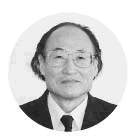
FUGONO Nobuyoshi (D.Eng.) President
The reorganization of ATR took effect on October 1, 2001, in
response to the government's modification of the funding system for ATR. This
change was outlined in the first volume of ATR UptoDate.
I am accepting full responsibility for the new ATR. Being concerned with ATR
in its early years and having followed its fifteen years of outstanding achievements,
I am now very pleased to contribute to ATR's continued and increased development
and to work with my distinguished and highly motivated colleagues. Now, I would
like to take this opportunity to communicate the substance of my views.
This new funding program has been implemented largely through two government-supported
organizations: the Telecommunications Advancement Organization (TAO) and the
New Energy and Industrial Technology Development Organization (NEDO). While
most of the details of this new program have not yet become clear, it is believed
to be improved in many respects and to offer better perspective than the former
program operated through the Japan Key Technology Center (KTC). For example,
requirements or suggestions derived from the investment have been dropped or
weakened. Competition for the research funds, however, is expected to be high.
Although the situation remains clouded, I can give this unequivocal message
to all my colleagues at ATR: Considering our outstanding research capabilities,
this change is clearly very advantageous to our research efforts. Welcome this
change ム we are surely better off under this new program.
ATR has grown to become an excellent research institute that attracts distinguished
researchers from many countries and diverse organizations. Throughout its 15
years of existence, ATR has enjoyed a stable and continuous flow of research
funding and has pursued innovative research born from stimulating discussions.
Moreover, ATR has achieved many outstanding results and has earned an unrivaled
reputation as one of the world's centers of excellence. I see no reason for
our institute to be considered undeserving under this new program, even if the
selection process for new research topics becomes more competitive.
ATR's most important duty is to continue generating outstanding results that
capture the attention of researchers worldwide. The keys to success for the
researchers are strong motivation and incentives. I have several ideas for providing
even greater incentives to high-achieving researchers, such as rewarding them
with good remuneration, providing stimulating feedback for excellent intellectual
property rights, ensuring good treatment in terms of rank and status, and offering
more flexible working conditions.
I also have a strong message for industry, which is now released from the burden
of funding research at ATR: in order to derive benefit from our institute's
successful results, even in the area of basic research, we ask that you maintain
a good level of cooperation by contributing researchers and knowledge to our
research projects.
Recognizing that our working environment has stood on the tranquil and stable
foundation provided by the KTC program, I believe that the key to ensuring ATR's
survival in the field of research is to engender a new appreciation for funding
among researchers. In today's more competitive environment, we should be ready
to compete to obtain funding in order to bring our research ideas and plans
to fruition.
As the new president, my first message to all ATR researchers is this: Be a
fighter and transform yourself into a competitive researcher.


